They are inseparable. |
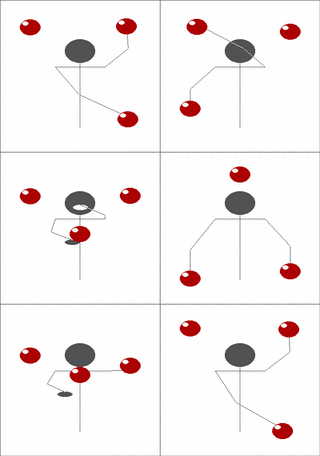 Three inseparable items. |
Security In Shipping |
|
|
Practical concerns of mariners, both those on-board ships and those assisting them from the shore, fall broadly into three areas.
They are inseparable. |
Three inseparable items. |
In this paper we will take a high level overview of some of the technologies available to port authorities to help them in each of these areas. This will, of necessity, be a somewhat personal view. The author has a Ph.D. in Pure Mathematics, a subject that some would say is not obviously useful, while others might even turn it around and say that it is quite obviously not useful! However, in working for Denbridge Marine Ltd over the past eight years it has become clear that the rather different and sometimes downright strange viewpoint this background affords has been of value in assessing the needs of both ports and pilots. While Denbridge's systems primarily provide VTMS capabilities for ports and offer assistance for the entire process from initial contact through to invoicing for services, their technologies have clear applications in all three of the major maritime concerns.
In an overview such as this, some parts of the document will, of necessity, cover material that is well-known to the reader. The author is well aware of this, and sometimes feels a little like he is explaining football to Beckham, or gravity to Newton. Such material is necessary, however, to ensure a consistency of treatment, and the reader's patience is appreciated.
A complete, in-depth analysis of all available technologies and their potential applications is well beyond the scope of this paper. If the reader has specific concerns, interests, suggestions or ideas then perhaps a subsequent paper could address them more fully.
As we stated above, the three main concerns are those of efficiency, safety and security. Before we can assess any technology against these issues we need some idea of what they mean and what they entail. Taking each in turn:
For monitoring ports and vessels there are several sensors readily available. These include, but are not limited to:
We will now take a brief look at four specific technologies and consider their strengths and weaknesses
As an emerging technology, Automatic Identification Systems have given rise to a great deal of excitement, speculation, discussion and interest. The automated transmission of data such as name, call-sign, position, course, speed, origin, destination, cargo, vessel dimensions, etc., has clear positive implications for each of our three criteria.
Radar systems were a tremendous boon when first introduced and have to this day remained a critical part of many operational systems. The ability to locate vessels at large ranges and monitor their movements has avoided uncountable collisions and streamlined many operations. It must be recognised, however, that radar only approaches its full potential when combined with other information sources such as VHF radio traffic and AIS information.
Considering radar in the light of our three areas of concern we can see that there are few, if any, negative aspects to having a radar system. Perhaps the most obvious negative is the initial cost of a system. A financial outlay of tens of thousands of pounds is considerable, especially when taking into account the slim margins on which ports survive. The advantages are significant.
This become even more relevant when the raw radar has been recorded and can be analysed days or even weeks after the incident. More about that below.
Sampling radar at a bit-depth of 8 bits (256 levels) and at a rate of 50MHz, digitised radar comes at a price -- 50MBytes of data every second. Of course, this is an over-estimate because in order to avoid the "fold-over" phenomenon there is an enforced period of silence between azimuths. Further, many radar systems discard some resolution by sampling to a bit-depth of only 4 bits (16 levels). Even so, raw digitised radar comes at about 5 to 10 MBytes of data every second. Recording this is obviously impractical, and thus we use data compression.
Standard off-the-shelf lossless compression technology can provide a compression ratio of between 5:1 and 20:1 on radar images, leaving us with at least 250 KBytes/sec, or 21 GB of data per day, more than can easily be archived.
There are radar compression technologies, however, that can compress raw radar data down to rates of 38.4 KBits/sec or even lower. This data rate results in only 3GB of data per radar per week, an amount that can easily be stored, transferred and analysed. We can now assess this technology against our three concerns.
Perhaps more importantly, the portable radar display can be configured to show a picture from a base radar station situated around the corner, showing an area of concern currently invisible to the ship's radar. Finally we have a "round-the-corner" radar capability. Transponder technology provides the same feature, of course, but it can only show the ships that are currently transmitting.
In an overview such as this can be few concrete conclusions. We do observe, however, that there is a recurring theme. Just as we must consider all three concerns, money, safety and security, so we must consider all technologies. It is the integrated approach that offers the most benefits, above and beyond the simple addition of features and facilities. Each technology can combine with each of the others to give new capabilities and new features. The question is not one of what is possible, but simply one of how much do you need.
Every ship is different, every port is different. Each must assess their own need for efficiency, safety and security. Our hope is that we've offered a fresh view on some old ideas, and an insight into some of the newer ones.
Colin Wright graduated with a B.Sc.(Hons) from Monash University in Melbourne, Australia, and has since obtained a Ph.D. from Cambridge, England, each in Pure Mathematics. He has worked for Denbridge Marine Ltd since 1993, specialising in raw radar data compression and vessel tracking technology, and can be reached by sending mailto:colin.wright@denbridgemarine.com
© C.D.Wright, Denbridge Marine Limited, 2002
Contents |
Links on this page |
|
 Suggest a change ( <--
What does this mean?) /
Send me email
Suggest a change ( <--
What does this mean?) /
Send me email

|
Quotation from Tim Berners-Lee |

|