Patterns Fail Proofs Prevail |
|
|
|
A Mathematics Talk given by Colin Wright Tagged As Talk Description |
It's all too common to try a few examples, find a pattern, try a few more examples, see that the pattern continues, and then leap to the conclusion that the pattern continues forever.
Beware!
|
|
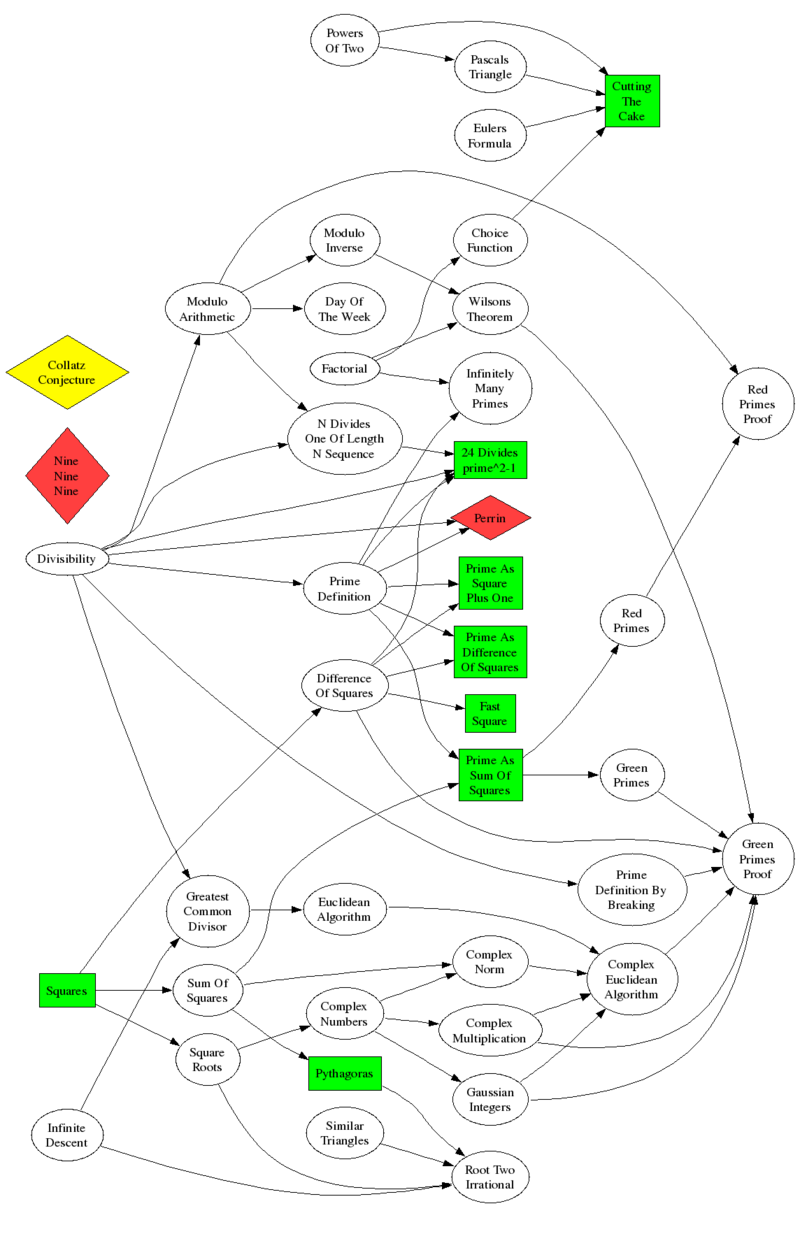
Shown here at right are some of the concepts that might be covered. I say "might" because there is too much to cover in a single lecture/presentation, so parts are left out, parts are glossed over, and there are some things that are mentioned that aren't on the diagram.
The boxes in green are the concepts that are pretty easy to explain without any additional ideas. For example, consider $5^2-1$ and $7^2-1.$ The number 24 is prominent, so try $9^2-1.$ Hmm. What about $11^2-1?$ Ah, there's 24 again. And in $13^2-1,$ but not $15^2-1.$ Again in $17^2-1$ and $19^2-1,$ but not $21^2-1.$ We form the idea that for any prime $p,$ $p^2-1$ is divisible by 24.
Does this always work?
What about expressing a prime as a square plus 1. Can you do that? Can you do it again?
And so forth.
The arrows on the diagram indicate dependencies. We need to know what a prime is before talking about a prime being the sum of two squares, but we need to talk about divisibility to define primes.
A couple of explanations:
ContentsThere were no headingsin the main text so there is no table of contents. |
Links on this page |
|
 Suggest a change ( <--
What does this mean?) /
Send me email
Suggest a change ( <--
What does this mean?) /
Send me email

|
Quotation from Tim Berners-Lee |

|