2008/12/14 Simplistic actions, unfair results
I admit that I enjoy watching the BBC's Strictly Come Dancing. I wouldn't say
I'm a fan, but I do enjoy it. But now I'm somewhat annoyed.
After last night's show, two of the couples were tied on three points from the
judges, with another on only one point. The show finished, the vote started,
and the live results program was later that evening.
|
And I thought:
|
|
"Tom only has 1 point, so he absolutely must be in the dance-off.
"I like Tom's dancing better than Lisa's dancing, and I think he would have
a better chance in the dance-off against Lisa than he would against Rachel.
"If Rachel ranks above Lisa in the viewer vote, then Tom will dance against
Lisa, and that's the best I can hope for.
"That means that if I vote, I should vote for Rachel." |
|
|
Well, I didn't vote - I didn't, and don't, care enough. And it's just as well.
Now it's announced that the vote got suspended, all couples are through to the
final, and the votes will now roll-over to next week.
That's unfair, unjust, possibly immoral, and very likely illegal. If I had
voted for Rachel, my vote would now count against my preferred winner. Surely
I'm not the only one who analysed things in that way, and so the arbitrary actions
of those in charge have now artificially boosted Rachel's chances of winning.
Good one BBC. Nice to see that you clearly have no idea.
2008/11/18 Simple tools, powerful results
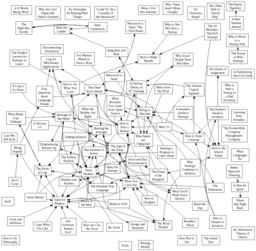
I've been reading some of Paul Graham's essays again, and was struck by how
inter-linked they are in some senses, but not others. You can find them here:
So I downloaded them, and looked at the html for links between the pages.
Hmm. Mass of data - how to visualise.
Then I fired up the GraphViz tool and drew the graph. Brilliant tool.
Simple in conception, sophisticated in implementation, and fantastically
powerful in action.
The original version was simplistic and used the page names rather than
their title, and it wasn't clickable. I also thought there was going to
be a better layout, so I've touched the problem again. The results are
on Paul Graham Essays.
Click on a few - they'll repay your time.
2008/11/08 Did they think it through? Really?
I've recently travelled by air again, and I thought I'd give the new station at
Liverpool South Parkway a go. It seems that from a regular rail station you can
buy a ticket to the airport, then catch the train to Liverpool South Parkway,
then any one of several shuttle buses to the terminal itself. Sounds like a
great idea, and certainly beats taking the car and parking, or a taxi.
So I turn up at the station - slightly skeptical, and ask for a ticket to the
airport. No problem.
Well, actually, small problem. It seems I can't buy a period return. They do
singles, of course. Slightly less obviously they do day returns, just in case
you want to visit the airport for the day. What they don't let you do is go
today, and come back tomorrow.
That seems a bit daft. It's not often I want to go to the airport just for the
day, but there you go.
So I buy a single.
You may see where this is going, but I didn't. It was, after all, morning, and
I'm not at my best in the mornings.
So now I've returned, and I'm looking to buy my ticket to go home. Only I can't.
There is no train station at the airport. It seems that I need to buy a bus
ticket to a station, and only then can I buy a ticket for the train.
So all the advantages have suddenly evaporated. Why can't I buy a period return
from my home station? Why can't a buy a single through ticket from the airport
to home? Did anyone think this through?
Did anyone think at all?
2008/09/28 Celebrating Genius in the Small
I couldn't say it much better, and don't have much to add. All I can really
do is highlight the point.
Theory is fine, theory is hard, theory is essential, but turning theory into
practical and useful devices that make the difference to our lives is a rare
gift, insufficiently celebrated.
2008/09/04 Pardon?
When I'm in a new country I always learn to say "I'm sorry, but I don't speak XXX"
in the local language. It's important not to get the grammar or accent perfect,
because I've found that the result is usually a reply in an incomprehensible
stream of what you've just said you can't speak.
Bother.
Anyway, I know how to say that I can't speak Swedish, and for some reason I
can't reasonably explain I recently put it into Google's translation system
The result was interesting:
| Original text: (Swedish) | Jag talar inte svenska |
| Translation: (English) | I do not speak English |
Not sure I can put my finger on exactly what's worrying me about this ...
2008/08/21 The Dilemma of History
I'm standing in the middle of a temple to Mithras as I write this. We're in
the last stages of a holiday in Hadrian's Wall country, and we're somewhere
near the wall in a rectangle of stone walls. The ground around is soggy damp,
and there's an apologetic little stream flowing in beside the front doorstep,
almost ashamed to be entering, and sidling up to join its friends in the small
puddle.
There's a plaque that does its best to show what it was all about, and what it
might have been like. It talks about the rituals as best they can deduce, and
there is a picture of how it may have looked.
But it's actually all a little sad. The cows are in the field above, pulling
up the grass and solemnly chomping away. The ground can't decide whether it's
grass, bog, mud or what, and we're here, in the middle of a large expanse of
nothing much.
What was it like? How can we remember it? Does it do it justice to see it like
this? The purists don't want it rebuilt, or reconstructed, or otherwise touched,
but is it really fair to leave it as hang-dog as this?
2008/08/20 Sense of Wonder
Visiting Alnwick (pronounced Annick) gardens (not the castle this time - that's
a separate attraction). They have a fantastic water garden sculpture section -
brilliant. Each sculpture is attractive in its own right, but most are inspired
by, or clearly demonstrate, a scientific principle.
There's a "fountain" that uses the Coanda effect, a fountain that shows the
principle of hydrostatic pressure, and one that's an exquisite example of a
vortex. And more.
The kids, or course, didn't care. They were having a great time playing in the
water - the principles and ideas going straight over their heads. But that's not
the point. Exposing them to these effects now, letting them experience the way
things work and making it part of their lives, means that they have some context
should they choose to study them later, or some understanding of the ideas behind
difficult questions like how aeroplanes fly.
Surely this is an unalloyed "Good Thing(tm)".
But then I wondered.
Suppose we experienced on a daily basis some of the minor miracles of physics
and engineering. What would we have left to cause intrigue and wonder?
Suppose it was obvious that light is both a particle and a wave. Suppose it
was obvious that things got shorter as they travelled faster. Suppose it was
obvious that clocks went faster as you climbed a mountain. What would there
be left to marvel about?
Kids I know take it for granted that Sat Nav systems can tell them where they
are, and guide them to wherever they want to go. They have no idea how it
works, and in many cases they simply don't care. Technology is becoming - has
become - so ubiquitous that the sense of wonder is gone, and there is nothing
left that makes them go "How does that work?" The answer is always just "It's
a computer."
But where will we get the scientists, engineers, programmers and mathematicians
of tomorrow? How can we create that sense of "Wow!", and not just from the ever
increasing, and increasingly pointless, eye-candy of computer games and CGI "action."
How can we make kids interact with the real world, shape the real world, create
the real world, and not just be passive passengers, experiencing, but never contributing.
Computers do everything these days, but how does a computer actually work?
2008/06/21 Truth from any source ...
Found in many places on the 'net, repeated often, frequently mis-attributed,
and it's popular because there is truth.
14 Rules for the Real World by Charles J. Sykes
- Rule 1: Life is not fair - get used to it!
- Rule 2: The world won't care about your self-esteem. The world
will expect you to accomplish something BEFORE you feel good
about yourself.
- Rule 3: You will NOT make $\$$60,000 a year right out of high school.
You won't be a vice-president with a car phone until you earn both.
- Rule 4: If you think your teacher is tough, wait 'til you get a boss.
He doesn't have tenure, so he tends to be a bit edgier. When you
screw up, he's not going to ask you how you feel about it.
- Rule 5: Flipping burgers is not beneath your dignity. Your Grandparents
had a different word for burger flipping: they called it opportunity.
- Rule 6: If you mess up, it's not your parents' fault, so don't whine
about your mistakes, learn from them.
- Rule 7: Before you were born, your parents weren't as boring as they
are now. They got that way from paying your bills, cleaning your
clothes and listening to you talk about how cool you thought you
were. So before you save the rain forest from the parasites of your
parent's generation, try delousing the closet in your own room.
- Rule 8: Your school may have done away with winners and losers, but life
HAS NOT. In some schools, they have abolished failing grades and
they'll give you as MANY TIMES as you want to get the right answer.
This doesn't bear the slightest resemblance to ANYTHING in real life.
- Rule 9: Life is not divided into semesters. You don't get summers off and
very few employers are interested in helping you FIND YOURSELF. Do
that on your own time.
- Rule 10: Television is NOT real life. In real life people actually have to
leave the coffee shop and go to jobs.
- Rule 11: Be nice to nerds. Chances are you'll end up working for one.
- Rule No. 12: Smoking does not make you look cool. It makes you look
moronic. Next time you're out cruising, watch an 11-year-old with a
butt in his mouth. That's what you look like to anyone over 20. Ditto
for "expressing yourself" with purple hair and/or pierced body parts.
- Rule No. 13: You are not immortal. (See Rule No. 12.) If you are under the
impression that living fast, dying young and leaving a beautiful
corpse is romantic, you obviously haven't seen one of your peers at
room temperature lately.
- Rule No. 14: Enjoy this while you can. Sure parents are a pain, school's
a bother, and life is depressing. But someday you'll realize how
wonderful it was to be a kid. Maybe you should start now. You're
welcome.
From some points of view these are going to sound pretty smug, really. But
like so many things in life, don't dismiss them just because you can find
flaws. Instead, try to learn something of value. Take the chance to become
a better person.
2008/06/17 Maths in the Media
There isn't enough coverage of maths that presents a balanced
view of the subject and its practitioners. All too often the
demands of car-crash television results in programmes like
"Dangerous Knowledge", which proposes the thesis that doing
maths can, and often does, drive you mad. It doesn't hold
water, but it's usually only the extremes of anything that
get coverage. After all, they have to compete against Big
Brother series 752.
That's why it was nice to see a well-structured, thoughtful,
and above all accurate report on a maths event. Yes, it
suggested that the people there were slightly kooky, but at
least it didn't portray them as potential serial killers.
The Guardian:
2008/06/11 What should we teach?
|
"Curriculum" comes from the Latin for "racetrack, and
as soon as you have a race you have winners and losers. Is
that necessarily a good thing? |
I've been having some discussions recently with some teachers over
the question of the content of the ICT and mathematics curricula.
I was suggesting that using VB6 was a bad idea, as it produces bad
habits, and doesn't give the scope for what programming is really
about. They were saying that it gets results quickly, and ticks
the boxes for assessment.
Clearly this shows the two different points of view for the question:
- What do we teach, and why?
For the teachers, the externally applied motivation is clear - good
grades are everything. Getting good grades means the student feels
good, gets their place at University, or that job, the school gets
a good assessment, and so on. The externally provided motivation
is entirely about getting good grades.
The hope is that good grades indicate genuine achievement. The
perennial argument about A-Levels is exactly that - do A-Levels
now give the same indication of underlying achievement as in
previous years? But really the questions are:
- What do the candidates know?
- What can the candidates do?
And does the system of assessment give a true indication of that
underlying truth?
2008/04/20 The Humble Programmer
|
Edsger W. Dijkstra wrote in his paper "Aims for a Young Scientist" (EWD1055A.PDF):
- Raise your standards as high as you can live with, avoid wasting your
time on routine problems, and always try to work as closely as possible
at the boundary of your abilities. Do this because it is the only way
of discovering how that boundary should be moved forward.
- We all like our work to be socially relevant and scientifically sound.
If we can find a topic satisfying both desires, we are lucky; if the
two targets are in conflict with each other, let the requirement of
scientific soundness prevail.
- Never tackle a problem of which you can be pretty sure that (now or
in the near future) it will be tackled by others who are, in relation
to that problem, at least as competent and well-equipped as you are.
- Write as if your work is going to be studied by a thousand people.
- Don't get enamored with the complexities you have learned to live
with (be they of your own making or imported). The lurking suspicion
that something could be simplified is the world's richest source of
rewarding challenges.
- Before embarking on an ambitious project, try to kill it.
- Remember that research with a big R is rarely mission-oriented and
plan in terms of decades, not years. Resist all pressure -- be it
financial or cultural -- to do work that is of ephemeral significance
at best.
- Don't strive for recognition (in whatever form): recognition should
not be your goal, but a symptom that your work has been worthwhile.
- Avoid involvement in projects so vague that their failure could
remain invisible: such involvement tends to corrupt one's scientific
integrity.
- Striving for perfection is ultimately the only justification for
the academic enterprise; if you don't feel comfortable with this
goal -- e.g. because you think it too presumptuous -- stay out!
This paper implicitly exhorts people to have a degree of humility. It
shows a healthy regard for the abilities of others, and requires that you
work on something useful, for which you will be recognised.
|
Recently I've been have a "discussion" on-line with someone about being humble.
He quotes a definition as:
- humble: low or inferior in station or quality
Somehow he concludes from this that to strive to be humble means to become low
and inferior. Aim low - do not aim high. Do not aim for perfection. Just be nice,
and let things slide.
As so often happens in English, "Humble" has several definitions. In encouraging
people to show more humility we are not asking them to become low in station -
that would be ridiculous. Taking "humility" to imply that you are striving for
low standards is ludicrous. Clearly if someone is encouraging us to be humble
they must have something else in mind.
Assuming there is meaning in the exhortation, another meaning of "humble" must
be relevant. Here is a definition from the Concise Oxford Dictionary:
- "Humble: Having, or showing, a low estimate of one's own importance."
That sounds more likely. The exhortation is that everyone should recognise
that others may genuinely be better - that is what it means to have a degree of
humility. Accept that others may know more, and be smarter, and strive to convince
them. In doing so you gain credence and reputation. To do otherwise, to criticize
others and simply state things as if they are self-evident truths for lesser mortals
to accept without question, is to start by alienating them. Then either you're
wrong, thus losing status, or you're right, fostering resentment. In Dale Carnegie's
book "How To Win Friends And Influence People" he talks about how to get along with
people, and how to convey information in a way that makes them want to accept things
that are right. The book is seriously dated now, but people haven't changed all that
much, and the truths, although quaintly (and sometimes insultingly) expressed, are
truths nonetheless.
Edsger W. Dijkstra was perhaps one of the most influential members of
computing science's founding generation. A web site of his writings is here:
It is all good reading, some technical, some sociological, some ranting, but all
informative, even if you don't agree with it.
2008/03/21
I've been browsing YouTube ( http://www.youtube.com/ ) a
bit lately. A friend and I have been working on a puzzle,
and now he's filmed it and put it up, here:
It's a really good puzzle - see if you can work it out.
Anyway, I went and had a look. Then I started following
links, and looking at other videos, and on it goes. I'm
sure you know what I mean. Even if you're a complete
luddite you may have lost yourself for a time reading a
dictionary or encyclopedia, perhaps especially if you're
a luddite.
Sorry - "late adopter."
On 2005/06/14 I wrote this:
|
It has been said that the internet, and the World Wide Web in
particular is a great leveller, a great equaliser. It gives
pretty much anyone the ability to publish on a world-readable
medium what ever they want to say ... what we've discovered
upon giving everyone ... the ability to publish, is that most
of them don't have anything interesting to say.
|
I should like to consider the folk song and expound briefly
on a theory I have held for some time to the effect that the
reason most folk songs are so atrocious is that they were
written by the people. If professional song writers had
written them instead, things might have turned out considerably
differently
- Tom Lehrer,
- introduction to the song 'Clementine'
|
We've also now found that they can't even say it well. The
spelling, grammar, production, accuracy and content are all,
generally, utterly appalling.
It's a deeply worrying trend, actually.
News sites used to find their own news, report it as clearly
and even-handedly as they could. Admittedly, many have, or
had, a strong bias, some were downright one-sided, but at
least what they produced was well-produced. Now stories are
followed by poorly thought-out, poorly constructed, poorly
phrased and content-free rants.
George Bernard Shaw said "People would sooner die than think.
And most of them do." Why are we being subjected to the
endless, mindless drivel.
The BBC news site says:
|
Help us make the news, with your pictures, views and stories. |
|
Good writing is hard, and now, thanks to being swamped by
the volume of value-free, well, let's just say twaddle, it's
hard to find anything actually worth reading.
2008/03/04 Sight for sore eyes
The original
I knew I was coming fown with a colf.
I left work early and went home, and wasn't olooinf
dorwaed to doing the trakj the next dat, Stukkm U
didn;t reakky gave a choice.
On the way back I felt like I had a pueve of grit in
my eye. Nothing seemed to hekp, and it was getting
more and more blookshot.
Saturday evening it felt like it was full of grit.
Sunday morning was wrose, but it got a little better
during the day. Monday it was bad again, so I went
to the optician. He referred me to the eye clinic at
Arrowe Park, where I saw a very nice man who toild me
to keep my eyes closed.
In essence, the cold virus had taken hold in my eye
membranes, and it was just a cold in the wrong place.
Keep an eye on it, so to speak, but let it run its
course. Keep my eyes closed, and it would sort itself
out quicker. Open them only as necessary.
It's an interesting experience. How often do you try
to do things with your eyes closed. Do you give any
thought to how to make things easy for those with a
visual impairement?
Interesting thing. As I was typing this, Windows
produced a "popup" to ask me if I wasnted some action
of other, and half my input therefore went to the wrong
place. Interfaces that do that are funadamentally broken.
They;re also surprisingly common.
Admittedly I don't have anyt of the visual imparitment
settings turned on, but even so . Why make it harder?
|
|
Corrected
I knew I was coming down with a cold.
I left work early and went home, and wasn't looking
forward to doing the talk the next day, Still, I
didn't really gave a choice.
On the way back I felt like I had a piece of grit in
my eye. Nothing seemed to help, and it was getting
more and more bloodshot.
Saturday evening it felt like it was full of grit.
Sunday morning was worse, but it got a little better
during the day. Monday it was bad again, so I went
to the optician. He referred me to the eye clinic at
Arrowe Park, where I saw a very nice man who told me
to keep my eyes closed.
In essence, the cold virus had taken hold in my eye
membranes, and it was just a cold in the wrong place.
Keep an eye on it, so to speak, but let it run its
course. Keep my eyes closed, and it would sort itself
out quicker. Open them only as necessary.
It's an interesting experience. How often do you try
to do things with your eyes closed? Do you give any
thought to how to make things easy for those with a
visual impairment?
Interesting thing. As I was typing this, Windows
produced a "popup" to ask me if I wanted some action
or other, and half my input therefore went to the wrong
place. Interfaces that do that are fundamentally broken.
They're also surprisingly common.
Admittedly I don't have any of the visual impairment
settings turned on, but even so. Why make it harder?
|
I was half surprised at how readable was the version
that I created with my eyes closed, but also half
disappointed. Perhaps I should finally learn to
touch type properly.
2008/02/11 The Quiet Zone
I'm travelling again, and I've found myself
in the "Quiet Zone".
I'm sure those of you who travel by train a
reasonable amount have seen the idea. Just
as some coaches used to be designated as
smoking, and if you smoke you went and sat
in those coaches, in this case it's "Being
Quiet" that's banished to the special coach.
And the analogy is surprisingly accurate.
Just as in the case of the smoking coach,
if you didn't smoke you were still allowed
to go in there. In the case of the "Quiet
Zone", people who aren't quiet do, indeed,
still go in there.
The sign on the window, indeed, on every window, says
Sit back and relax...
Please refrain from using mobile phones,
and creating unnecessary noise - thank you.
Quiet Zone. |
The "Q" has headphones on, and the "i" is
actually a mobile. Very sweet.
Great idea too. It means that people on long
trips and having to get some work done - thinking
style work - have the chance to do it without
the distraction of mobile ring tones, loud
conversation, and all that "unnecessary noise".
Which is, of course, right alongside
"necessary noise". In the last 20 minutes
I've heard nearly 30 telephone calls and text
messages. Yes, I am sad, I have been counting.
So just as with the smoking coach, where it
was still permitted for non-smokers to go, we
have quiet coaches, where non-quiet people can
go. The ticket inspector does his best, but
people literally ignore him, too busy with
their conversations to pay attention.
And unlike smoking, mobile phone noise is
getting worse. And worse.
These days it's quite unusual for me to sit
in the quiet coach. It's just as
noisy as the others. You may wonder why I
bother specifically to hunt out the non-quiet
coaches if they are, indeed, pretty much the
same. The fact of the matter is that they are
pretty much the same, but at least the noise
is expected, and doesn't make me so bloody
annoyed.
2008/02/07 Moving to Broadband
Rachel and I are what are known as "Late Adopters". Although
people think of us as incredibly good with technology, the
truth is that we hate it, and only use it when we have to.
The problem is that we've both used technology that really
does work very well, so the vast majority makes us angry,
frustrated, and generally ticked off.
Most of the time it doesn't work as well as it could. Perhaps
as well as it should.
The reason is clear. Companies don't want to make you happy.
Companies want to make money. They will do as little as they
can get away with, reducing their quality of service until
the money they save is less than the money they lose.
Because customers are generally loyal, and forgiving, companies
can get away with reducing their services to a very, very poor
quality indeed.
And that's what happens in a competitive market. Sod the
customer, we have to compete, so we'll give them as little
as we can get away with.
Cynical? Me? I prefer to think of myself as realistic.
We'll chart some of our progress on the Moving To Broadband page.
See also:
Contents
| |
Links on this page
| |
Site hosted by
Colin and
Rachel Wright:
- Maths, Design, Juggling, Computing,
- Embroidery, Proof-reading,
- and other clever stuff.
|
|
 Suggest a change ( <--
What does this mean?) /
Send me email
Suggest a change ( <--
What does this mean?) /
Send me email
Front Page /
All pages by date /
Site overview /
Top of page